At a glance
AI can help sales teams prepare account research, organize discovery notes, and draft relevant follow-ups. The strongest workflow preserves source evidence and leaves relationship building, judgment, and message approval with the salesperson.
Define account fit before collecting more information
Write a practical description of the customers you can help: the business model, team responsible for the problem, relevant systems, and signs of a suitable project. A company using several disconnected tools may be a better fit for workflow integration than one with a simple process and little transaction volume. Make that reasoning explicit.
Separate qualification from assumptions about a person's needs. A job advertisement or public product announcement can suggest a useful discovery question, but it does not prove a company has a particular budget or internal problem. Give the AI clear criteria for inclusion and exclusion, then have a salesperson review unfamiliar accounts before investing in deeper research.
Build account briefs with visible sources
Use the company's own website, product documentation, and public announcements to establish what it does. Ask the assistant to record the source URL and the date checked next to each factual claim. A useful brief contains the offering, likely user group, relevant public change, and a short explanation of why the account may fit.
Mark interpretations as hypotheses. For example, a new distribution location might lead to a question about inventory coordination; it does not establish that the company has stock errors. Keep unknown fields blank instead of completing them with plausible details. The salesperson should be able to inspect the brief quickly and trace important statements back to evidence.
Turn research into a focused conversation
Ask AI to draft a concise opening that connects a verified observation with a relevant business question. The goal is to make the reason for the conversation clear. Avoid manufactured familiarity, inflated claims about the prospect, or language that implies a prior relationship. Read the draft aloud and remove anything you would not naturally say.
Prepare a small set of discovery questions around the current process, the people involved, and the cost of leaving the problem unresolved. An automation agency might ask how enquiries move into the CRM and where handoffs fail. Keep branching suggestions as preparation notes, not a script that prevents you from listening when the prospect changes direction.
Capture useful context without filling the CRM with guesses
After a conversation, use your approved notes to draft a structured recap. Separate what the customer said, what the salesperson inferred, and what was agreed next. A good CRM update preserves the customer's language around the problem and records the owner of the next action. Missing information should remain visibly missing.
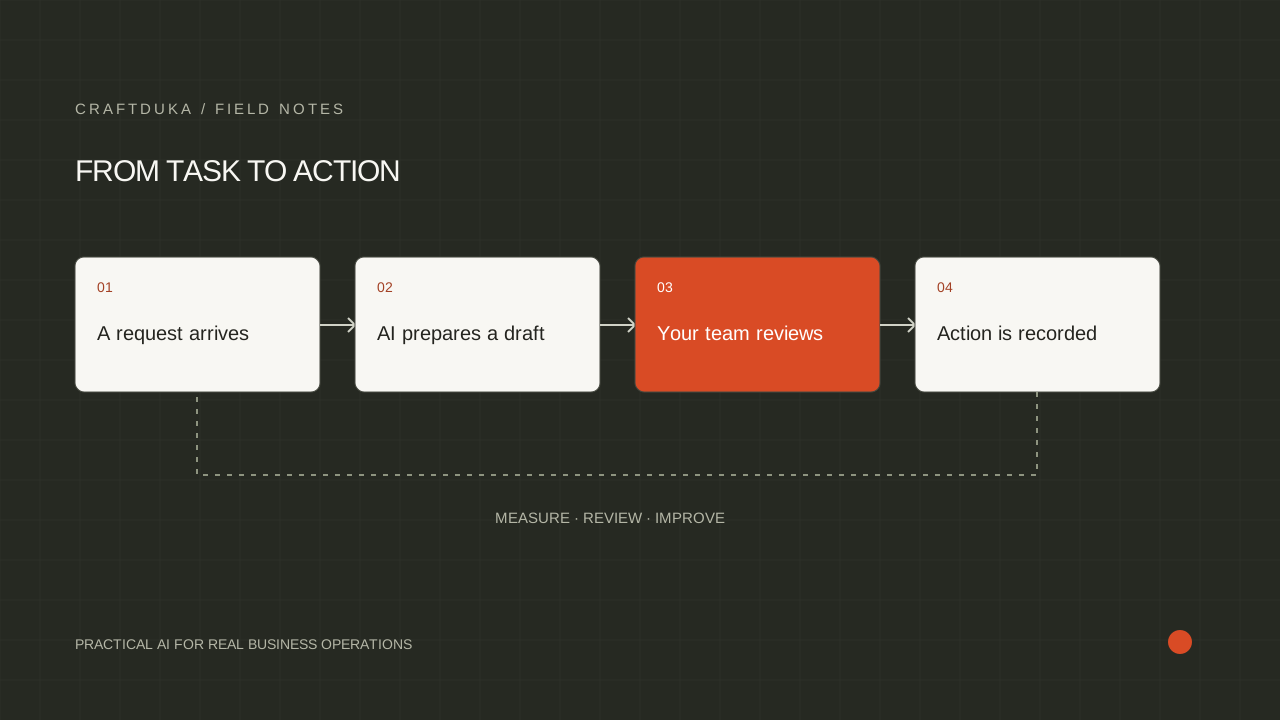
Review proposed updates before they become permanent records or external messages. n8n supports requiring approval for selected AI tool calls, which is one way to implement this boundary. For example, an assistant could prepare a follow-up and proposed CRM fields while a salesperson checks the recipient, factual accuracy, and promised next step before either is submitted.
Measure quality across the sales process
Track research time, useful conversations, qualified opportunities, and the frequency of corrections to generated briefs. A system that creates more messages may also create more irrelevant work. Review rejected drafts and unsuccessful account recommendations to learn whether the issue is targeting, evidence quality, messaging, or the underlying offer.
Keep experiment groups comparable when trying a new briefing format. Use the same qualification criteria and follow-up process so a change in results can be interpreted. Let salespeople record why a recommendation helped or failed. Those explanations create a more useful improvement backlog than treating response rate as the only measure of an AI sales workflow.
- Preserve links to evidence in each account brief.
- Require a human review before sending outreach.
- Record agreed actions separately from AI suggestions.
Key takeaways
- Separate verified account facts from hypotheses before they enter a sales brief.
- Use AI to prepare focused questions and drafts that a salesperson reviews.
- Measure qualified conversations and CRM accuracy alongside preparation time.
Frequently asked questions
Can AI write all of a salesperson's outreach?
AI can prepare drafts, but a salesperson should verify the account facts and decide whether the message is appropriate. Final review is especially important when the draft names a business problem the prospect has not confirmed.
What should an AI account research brief contain?
Include verified company information, source links, qualification reasons, open questions, and a proposed conversation angle. Label unverified interpretations clearly so they cannot be mistaken for customer statements.
How can a small sales team start?
Use a shared brief template and test it on a small set of accounts the team already understands. Compare research quality and preparation effort before connecting the workflow to CRM writes or message sending.