At a glance
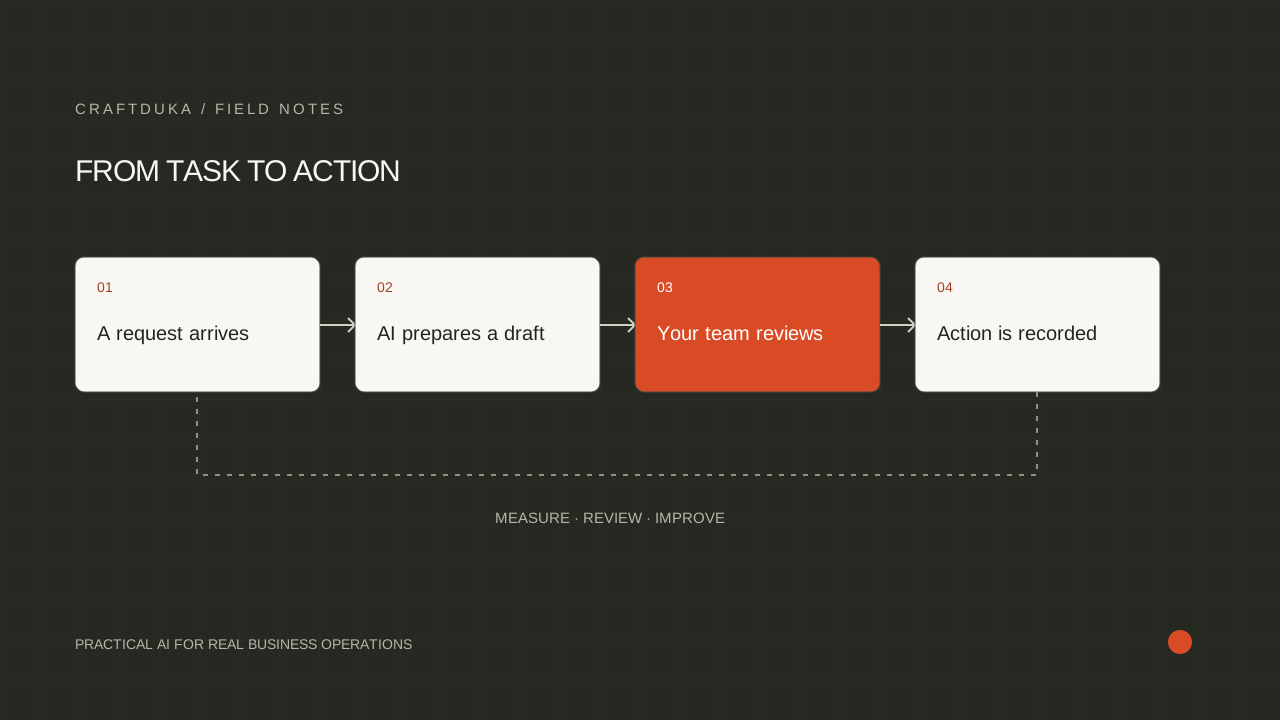
A useful AI automation roadmap starts with one measurable operational problem. Map the existing work, separate rules from language tasks, test with representative examples, and expand only when the workflow produces dependable outcomes.
Start with a bottleneck your team can describe
Ask the people doing the work where information gets copied, requests wait, and avoidable corrections happen. A useful candidate might be turning inbound enquiries into structured CRM records or preparing a support reply from approved documentation. Describe the current process before choosing a model or an automation platform. If nobody owns the process, assign an owner before automating it.
Record the volume of work, the time required for a typical case, and the common exceptions. Separate active handling time from waiting time so the baseline is meaningful. A workflow that saves drafting time may still create a queue at the approval step. Your first pilot should address a complete, narrow handoff that a team can observe.
Decide which steps actually need AI
Use straightforward rules when the decision is deterministic: a required field is present, an order exists, or an amount falls within an approved range. Use AI where language varies, such as classifying an enquiry, extracting a requested service, or drafting a summary. This makes the system easier to explain and reduces unnecessary model calls.
Write down the boundary between a suggestion and an action. An assistant can propose a CRM update without receiving permission to change every customer record. Define allowed fields, permitted tools, and the conditions that require review. n8n's human review documentation provides one implementation pattern for pausing selected AI tool calls until a person approves or denies them.
Prepare a small, representative evidence set
Collect examples that reflect the work the pilot will encounter. Include clear requests, incomplete messages, duplicates, unusual wording, and cases that should be escalated. Remove information the pilot does not need. For a support assistant, establish which help articles are authoritative and who is responsible for keeping them current.
For each example, write the expected outcome before evaluating the system. The expected result might be a category, a list of extracted fields, or a correct decision to ask a clarifying question. Keep some examples outside the development set. Otherwise, a workflow can appear capable simply because its instructions were repeatedly adjusted around familiar cases.
Run the pilot alongside the existing process
Begin by generating drafts or suggested actions for a small operational scope. Let the responsible team compare those suggestions with their normal decisions. Capture corrections with reasons, such as missing context, unsupported claims, or incorrect routing. This feedback is more useful than a single thumbs-up score because it points to a fix.
Set a stopping rule before launch. Repeated unsupported answers, a broken integration, or an increase in unresolved work should trigger a pause and investigation. Maintain an ordinary manual route for cases the automation cannot complete. A pilot needs a working fallback and a named operator as much as it needs a good demonstration.
Expand according to evidence
Review completed outcomes rather than counting model responses. Compare total handling time, accepted suggestions, reopened work, and the effort spent correcting errors. Include model usage, integration maintenance, review time, and support in the operating picture. A lower drafting time is useful only if it improves the wider process.
Document what worked, what remains outside scope, and which changes would justify another evaluation. Microsoft describes evaluation, monitoring, and tracing as complementary parts of operating generative AI systems. Use that distinction in your handover: define how quality is checked, how failures are noticed, and how an operator reconstructs what happened.
- Keep the original process available during rollout.
- Assign an owner for documents, integrations, and incident handling.
- Retest representative examples after changing models, prompts, or connected systems.
Key takeaways
- Prioritize a repeated task with a clear owner, usable data, and a measurable baseline.
- Let AI interpret language while explicit rules control permissions and business actions.
- Evaluate successful outcomes, correction time, and operating costs before expanding.
Frequently asked questions
What is a sensible first AI automation project?
Choose a frequent task with clear inputs and an outcome a person can verify, such as enquiry classification or an internal support draft. Avoid starting with a process whose data, ownership, and decision rules are still unresolved.
How should a business calculate the benefit of a pilot?
Compare the complete process before and during the pilot, including review, corrections, and operating costs. Report the baseline and sample size alongside the result so the team can judge whether the improvement is meaningful.
Does every automation need an AI agent?
No. Many useful workflows combine ordinary rules with a single classification or drafting step; an agent is appropriate only when the task needs a controlled choice between tools or steps.