At a glance
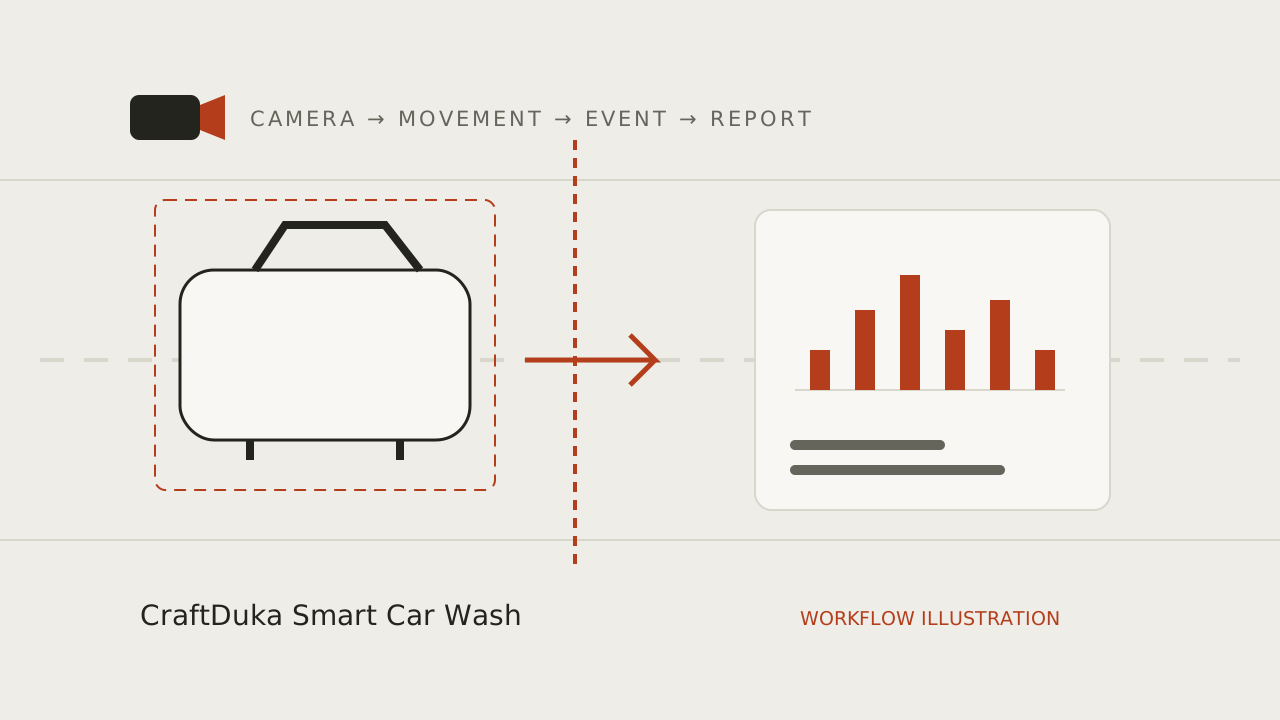
AI car wash monitoring uses camera footage to estimate vehicle movements across a defined entrance or exit. It can help an owner understand traffic patterns without watching recordings all day. It does not independently establish completed washes or revenue. CraftDuka is developing this workflow in Kenya; its current proof of concept connects a V380 camera to Hermes Agent and sends images through WhatsApp. Automated counts and dashboards still require development and validation.
Why owners need an independent traffic record
An owner working away from a car wash often receives a closing message with a total for the day. That message may be accurate, yet it rarely explains when visitors arrived, whether a queue formed or how long the entrance camera was offline. Manual reporting also puts record keeping onto staff who are already handling customers, equipment and wash bays. An independent traffic log can give that conversation a consistent starting point.
Consider a Kenyan site that shares access with a tyre shop. A busy gate does not necessarily mean a busy wash bay. Separating entrance activity from booked services helps the owner decide whether to improve signs, record enquiries or adjust staffing. The useful question is which vehicles reached the business and what happened next. Treat an unexplained difference as something to investigate with the team, rather than evidence of misconduct.
What an AI camera counting workflow actually does
A camera supplies images of the gate. Software detects likely vehicles, follows each detection across successive frames and checks whether its path crosses a configured boundary. The event record can contain a timestamp, camera identifier, direction and a local tracking identifier. Counting movements over time creates an activity series that can be grouped by hour or operating day. These records are estimates until tested against observations of the same scene.
Detection answers whether a vehicle appears in an image; tracking tries to maintain continuity as it moves. A truck blocking a small car can interrupt that continuity. A driver reversing through the boundary can create another crossing. Good rules define how those situations are represented. The ByteTrack paper in the references describes one tracking approach; it is background reading, not a claim about CraftDuka’s chosen production architecture or measured performance.
Turn activity into questions your team can act on
Hourly entry counts can help identify periods worth observing more closely. If visitors arrive before a full shift starts, check whether queues and abandoned enquiries also rise. If a late afternoon peak repeatedly coincides with long waits, trial a different break schedule. Compare similar weekdays and keep notes about rain, public holidays, roadworks and promotions. A single busy Saturday does not establish a reliable seasonal pattern.
Historical comparisons need the same counting rules and equivalent coverage. Changing a camera angle or moving a virtual line can alter what gets counted. Record those changes beside the reports. For a petrol-station wash, a dedicated entrance view may be necessary to exclude general station traffic. For detailing, a vehicle can stay for many hours, so exits and entries will not necessarily balance inside the same reporting period.
Use WhatsApp for concise reports with context
A useful owner report should identify the site, date, timezone, reporting interval, entry total, exit total and gaps in camera coverage. A short peak-hour summary is often more useful than sending dozens of pictures. Keep recipients limited to people who need the information. A report delivered to a group can be copied or forwarded, so aggregation should be the default reporting goal where images are unnecessary.
CraftDuka’s demonstrated camera-to-WhatsApp path is an early technical building block. It does not yet demonstrate persistent vehicle tracking, reliable daily counting or a deployed reporting service. During a demo discussion, ask which steps can be shown today and which are proposed. For a production WhatsApp Business Platform workflow, recipient permission, approved templates where required, delivery handling and current platform charges must be assessed separately.
Assess your site before buying hardware
Photograph the entrance layout without collecting unnecessary customer details. Note each route into and out of the property, where vehicles wait, whether access is shared and what happens when deliveries arrive. Record the existing camera model and recorder model, how authorised users access them, and whether a supported video stream is available. An app showing pictures on a phone does not establish that another system can obtain a continuous stream.
Check power stability, weather exposure, lighting and the network path. A sheltered fixed camera with a clear gate view may be more valuable than a higher-resolution camera aimed over the whole yard. Arrange a safe mounting review and avoid creating cable hazards around water and vehicle movements. If internet connectivity is intermittent, specify what processing can continue locally and how any stored events would be synchronised after reconnection.
Build privacy and staff trust into the design
Vehicle counting should have a narrow purpose. Avoid adding face recognition, audio recording or individual productivity scoring just because a camera might support them. Explain the proposed workflow to staff, identify who can inspect records and provide a way to challenge an incorrect interpretation. Keep the camera view focused on the relevant access route and avoid collecting more of neighbouring premises than the task needs.
Kenya’s Data Protection Act is the primary legal starting point for handling personal data. Agree responsibilities with the technology provider and review the applicable requirements before a pilot. Document where images and event records would be processed, which third parties would receive them and how deletion works. The website’s general privacy policy is not a substitute for agreeing the data handling of a specific monitoring deployment.
Budget for validation and operation, not just a camera
Request a proposal that separates camera hardware, mounting, power protection, networking, processing, event storage, messaging, maintenance and support. Ask whether configuration changes and repeat validation are included. Existing CCTV may reduce hardware work but still require a new view or compatible recorder access. CraftDuka has not published a Smart Car Wash price list, and no standard Kenyan installation price or claimed payback period is assumed here.
Reliability depends on the whole chain. A clean camera view does not compensate for lost power, and a delivered WhatsApp message does not prove that the underlying count was complete. Rain, glare, queues and overlapping vehicles need explicit tests. The pilot should record missed crossings and extra events separately, because an apparently correct total can hide errors that cancel one another. Set acceptance criteria before using reports for important decisions.
A practical implementation checklist for a Kenyan owner
Begin with one entrance and one reporting question, such as understanding hourly arrivals during opening hours. Agree a written crossing definition and decide whether motorcycles, delivery vehicles and repeat visits belong in the total. Observe the gate manually during several different conditions, compare those observations with event records, and preserve the disagreement log. Ask staff to explain unusual movements so the rules reflect real operations.
Review the results before expanding. A successful pilot needs useful reports, explainable exceptions, coverage information, authorised access and an owner for faults. If the count is unreliable during the busiest hour, fix the view or narrow the use case rather than hiding the limitation in a daily average. Bring your entrance layout, camera details and reporting priorities to a CraftDuka consultation so the discussion can establish technical fit and present development readiness.
- Define the boundary, vehicle classes, direction and reporting timezone.
- Agree manual observation windows and acceptance criteria before testing.
- Document outages, privacy controls, retention and authorised recipients.
- Compare like-for-like days before changing staffing or investment plans.
Plan your monitoring workflow
Explore CraftDuka Smart Car Wash and its current pilot scope. Continue with these related guides:
- How to Automatically Count Cars Entering a Car Wash Using AI Cameras
A practical guide to entrance camera placement, vehicle detection and tracking, virtual counting lines, duplicate prevention and manual accuracy checks.
- How Car Wash Owners Can Improve Accountability Without Micromanaging Employees
Build fair car wash accountability with shift records, service logs and traffic reconciliation. Understand exceptions and protect staff privacy.
- Smart AI CCTV vs Traditional CCTV: Which Is Better for a Car Wash?
Compare traditional CCTV recording with AI vehicle event analysis, including camera compatibility, accuracy, deployment options, privacy and running costs.
Key takeaways
- Start with a specific operational question and a clear definition of a vehicle entry.
- Keep traffic events separate from service completion and payment records.
- Validate the actual gate view under busy, dark and wet conditions before relying on summaries.
- Agree privacy, outage reporting, costs and support before expanding a pilot.
Frequently asked questions
Can an AI camera replace my cashier’s records?
No. A camera event records movement. Your cashier or POS records the service sold, price, payment and adjustments. Keep both records and compare them using shared periods and documented exceptions. Visitors, returns and vehicles already on site explain why those totals may differ.
Will my existing V380 camera work?
The proof of concept used a V380 camera, but model, firmware, stream access and placement still need assessment. A successful connection for one device does not validate every device in the range, sustained counting or your network configuration.
Can I enquire before the full product is ready?
Yes. CraftDuka accepts demo and pilot enquiries. A consultation can establish your use case and show the current proof of concept. Feature scope, availability, pricing and validation expectations must be agreed before any deployment; an enquiry does not reserve a commercial launch date.