At a glance
An AI MVP should prove that a focused user task can be completed reliably enough to be useful. Scope the workflow, test with realistic examples, and make the release decision from quality and operating evidence rather than a fixed launch promise.
Choose one user job with an observable result
Describe the problem without using the word AI. A customer support lead might need to find the relevant policy and prepare a correct response faster. An operations manager might need to turn incoming documents into a reviewed record. Specify who does the work, what starts it, and what finished work looks like.
Keep the first product narrow enough that a user can assess its value. A document assistant that extracts a defined set of fields is easier to evaluate than an open-ended business copilot. List the tasks deliberately outside scope, such as approving payments or changing customer entitlements. These boundaries help the team estimate work and avoid an expanding demonstration.
Validate the information the product will depend on
Inventory the source documents, APIs, and systems needed to complete the task. Check whether the information is current, accessible, and structured well enough to use. A missing integration or inconsistent source record can matter more than the choice of language model. Establish who owns each source and how corrections will reach the product.
Prepare representative examples before polishing the interface. Include incomplete inputs, conflicting documents, and questions the system should decline or escalate. For a retrieval assistant, record the evidence that would support a good answer. If people cannot agree on the expected result, resolve that product question before using it as a model evaluation.
Design the smallest complete workflow
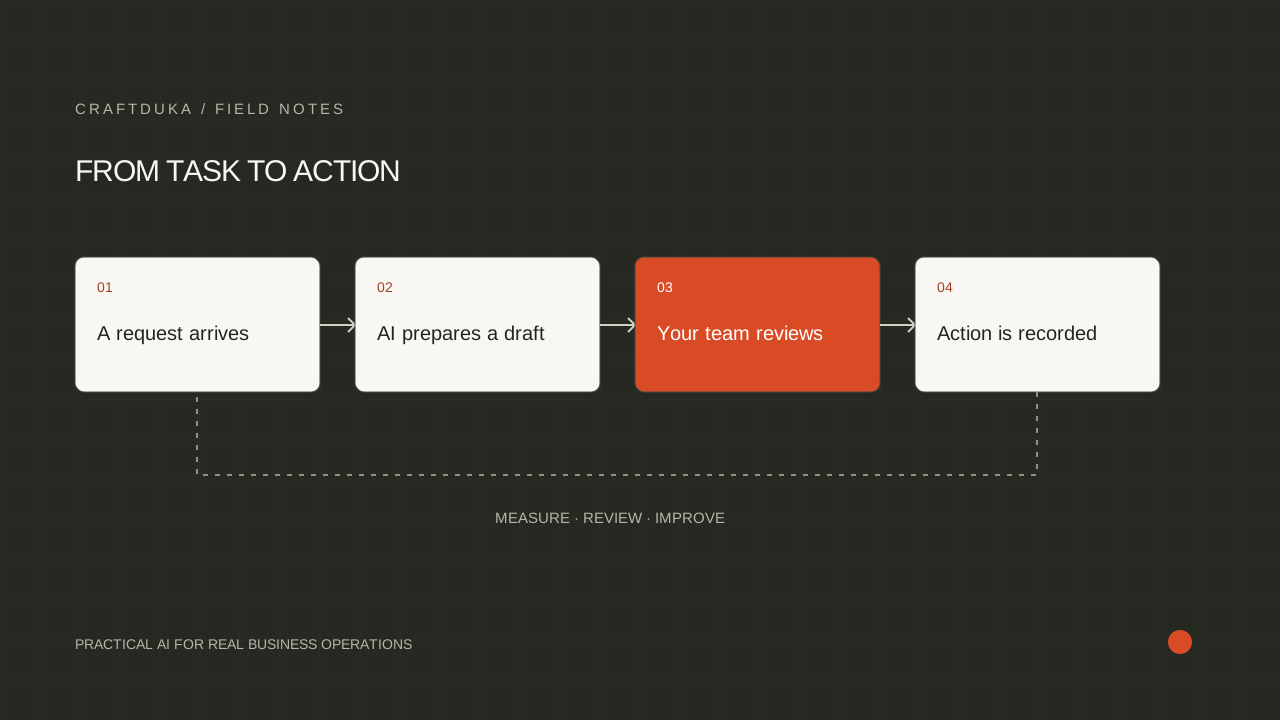
Map the path from input to useful output, including review and exceptions. For example, a user uploads a document, the system extracts selected fields, validation flags missing values, and a person accepts a proposed record. The MVP must make uncertain fields visible; hiding them behind confident prose creates extra work downstream.
Keep deterministic checks outside the model where possible. Validate required fields, permitted values, record ownership, and allowed actions in ordinary application logic. Restrict integrations to the access the pilot needs. A well-scoped workflow can use AI for a small part of the task while still delivering a valuable end-to-end product experience.
Evaluate quality and operating behavior together
Create a review rubric that reflects the task: factual accuracy, completeness, appropriate use of evidence, and correct escalation. Assess the output with people who understand the work. Also test slow responses, unavailable dependencies, and repeat submissions. A strong answer is not sufficient if the application loses work or repeats an external action.
Microsoft's observability guidance distinguishes evaluation, production monitoring, and tracing. Apply those ideas at a scale appropriate to the pilot: keep a repeatable quality set, track important operating signals, and retain enough context to investigate failures. Version the instructions and configuration so a change can be linked to its effect.
Release to a limited group with a decision plan
Select users who can complete real tasks and provide specific feedback. Explain the product's boundaries and give them a way to correct or reject output. Decide in advance what evidence would justify expansion, another iteration, or a stop. Include the time users spend reviewing and repairing the result when assessing value.
Set the schedule after examining the scope, dependencies, and evaluation work. A prototype can be quick while a reliable operational pilot requires additional integration and review. Document the remaining risks and ownership at handover. The result should be a product the team can operate and learn from, with a clear next decision rather than an unsupported launch guarantee.
- Keep a versioned set of representative evaluation cases.
- Record user corrections with a reason.
- Define who handles failures before inviting pilot users.
Key takeaways
- Scope one user task and define what a successful outcome looks like.
- Treat data access, evaluations, and fallback behavior as part of the MVP.
- Use evidence from a limited pilot to decide what deserves further investment.
Frequently asked questions
How long does an AI MVP take to build?
The timeline depends on the task, data readiness, integrations, quality requirements, and review process. A useful estimate follows discovery and a narrow scope; a fixed deadline alone cannot establish production readiness.
Do we need to train a custom model first?
Not necessarily. First test whether a suitable existing model, clear instructions, and access to approved information can meet the task's requirements before committing to additional model development.
What is the difference between an AI demo and an MVP?
A demo shows a possible interaction, while an MVP supports a defined user task with enough evaluation and operational handling to learn from actual use. It needs a way to detect, explain, and recover from predictable failures.