At a glance
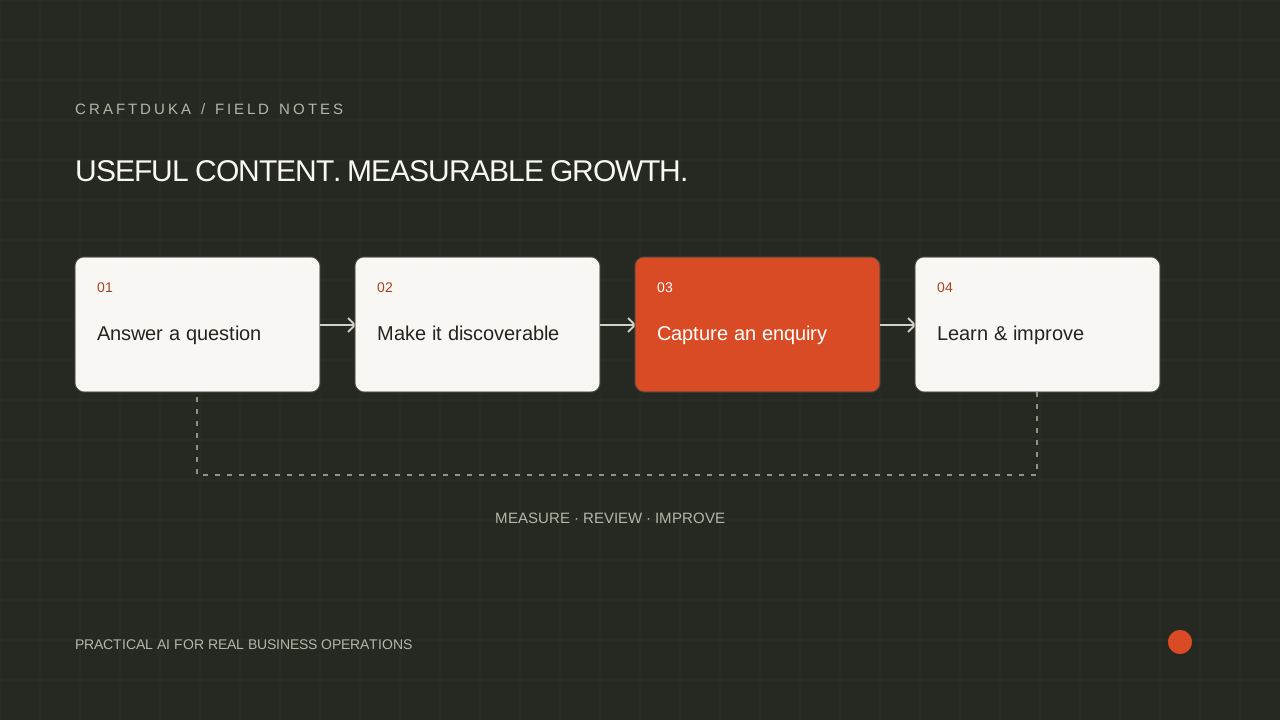
AI search visibility starts with pages that can be discovered, read, and understood. Publish clear answers backed by evidence, expose the content in accessible HTML, connect related pages, and measure indexing and qualified enquiries without promising AI citations.
Build pages around the questions buyers actually ask
Start with questions from sales calls, onboarding, and support. A prospective automation customer might ask what can connect to an existing CRM, which actions need human review, or what information is required before a pilot. Give each article a specific purpose and explain the answer near the beginning, then develop the steps, examples, and limitations.
Use headings that describe the decisions a reader needs to make. Include concrete inputs, expected outputs, and realistic exceptions. For an agency, a detailed explanation of how to scope a workflow is more informative than repeated claims about innovation. Link to the relevant service page when the reader needs to understand your implementation offering.
Make the full article accessible in HTML
Check a direct request to each article URL. The response should contain the article's title, main text, internal links, and useful metadata. Readers and automated systems should not need to click a button or sign in to reveal the core content. Use a single main heading and a logical sequence of section headings.
Google's AI features guidance says a supporting page must be indexed and eligible to appear with a search snippet. Its recommendations include accessible text, internal links, and allowing crawling through both robots.txt and hosting infrastructure. Inspect the production response as well as the code: an edge rule or deployment configuration can change what a crawler receives.
Make business facts specific and consistent
Your About page, service pages, contact information, and article bylines should tell the same story. State the company name, what it does, who it serves, and how to contact the team. Attribute articles to the actual author or publishing organization. Add relevant sources and describe examples as examples unless they are documented customer work.
Only publish results you can substantiate, with enough context for readers to interpret them. An automation case study should explain the original process, the implemented change, the measurement window, and the outcome. If those facts are not available, publish an implementation guide rather than inventing a case study, endorsement, client relationship, or performance percentage.
Connect metadata, structured data, and discovery paths
Use descriptive titles, page-specific summaries, stable canonical URLs, and useful sharing images. Keep the blog index and XML sitemap aligned with the actual article routes. Add links between related guides where they help a reader continue a task, such as moving from AI strategy to workflow reliability or customer support implementation.
Article structured data can describe the headline, author, image, and publication information; Google's article documentation explains supported properties. Keep those fields consistent with the visible page. Google also states that its AI Search features do not require a special AI text file or special schema. Optional discovery files should supplement a well-built site, not replace its content.
Measure discovery and useful visits
Use indexing tools to identify excluded URLs and inspect what search systems can access. Review landing-page visits, relevant search queries, referral sources, and enquiry quality. Keep a record of changes so you can compare meaningful periods. A search appearance can fluctuate, and a single AI response is not a reliable performance baseline.
Separate technical readiness from actual inclusion. A crawlable page with accurate markup can still be omitted from a search result or generated answer. Establish repeatable checks across a defined set of buyer questions, but treat those observations as a sample. The strongest ongoing content investment is answering useful questions accurately and updating material when the underlying facts change.
- Audit the HTML response, canonical URL, and indexing directives.
- Use real dates and update them when the content materially changes.
- Review broken links and outdated source references during editorial maintenance.
Key takeaways
- Make important content available as readable HTML at a stable, indexable URL.
- Explain your services and experience with consistent facts and specific evidence.
- Treat structured data and crawler access as foundations, not guarantees of AI inclusion.
Frequently asked questions
Does an llms.txt file guarantee visibility in AI answers?
No. It can provide a curated discovery aid, but it does not guarantee crawling, citation, or ranking, and Google does not require an AI text file for its AI Search features.
Should every article include FAQ structured data?
Use visible questions and answers when they genuinely help the reader, and only add structured data that accurately describes the page. Markup alone does not guarantee a special search appearance or AI citation.
Can an agency guarantee inclusion in AI Overviews?
No. An agency can improve technical access, clarity, and content quality, but the search provider controls indexing and the sources shown for an individual query.