At a glance
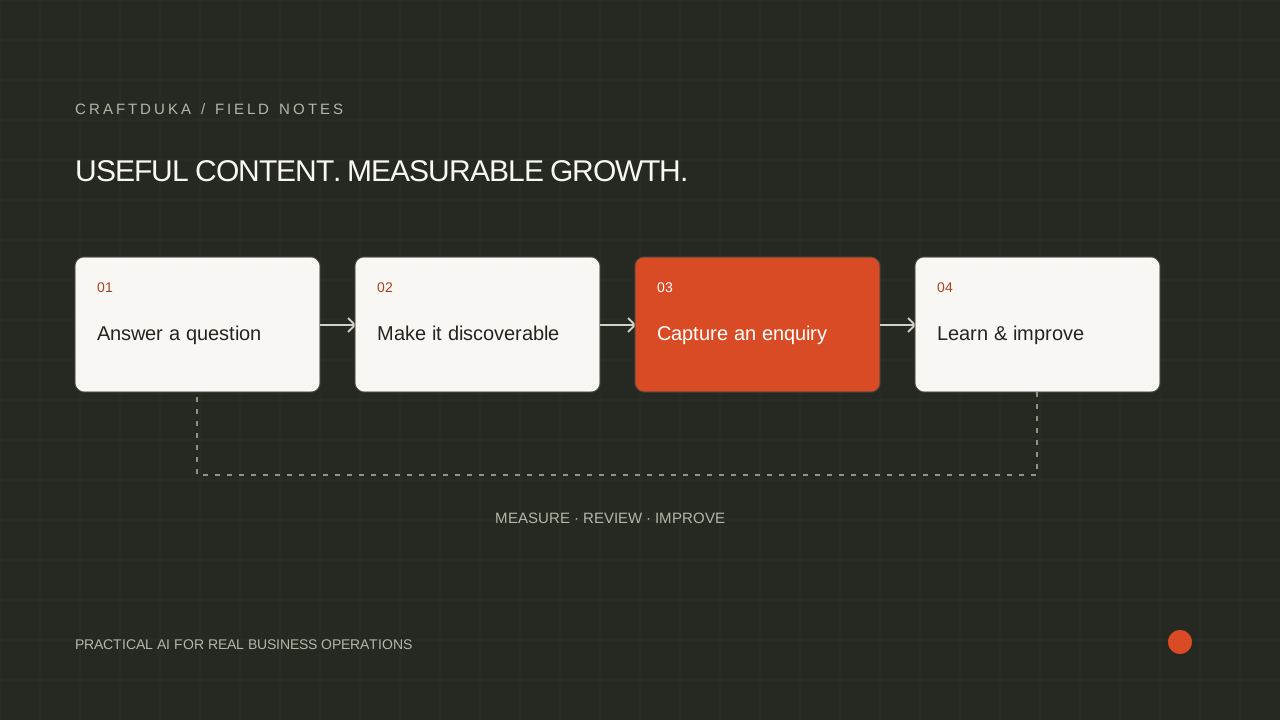
An AI marketing workflow should connect an audience problem to a useful campaign and a measurable outcome. Use AI to organize research and prepare variations, while people verify claims, approve creative work, and interpret the results.
Start with a business outcome and a clear audience
Choose the decision you want a prospective customer to make. For an AI agency, that might be requesting a workflow assessment after reading a guide about a problem they already face. Define the buyer's role, the operational challenge, and the information needed to take the next step. This gives the campaign a useful boundary.
Write one primary outcome and the supporting signals you will track. A form submission is an event; a relevant, qualified enquiry is a business result. Agree how sales will classify enquiries before launching the campaign. Otherwise, marketing can optimize for an easy action that creates little value for the people handling the resulting conversations.
Give AI a brief built from approved material
Collect product facts, service scope, customer questions, brand examples, and claims your team can substantiate. Ask the assistant to organize themes and draft possible angles from that material. Keep source notes with the brief so reviewers can verify important statements. Do not let a missing fact become an invented benefit or customer result.
Prepare a compact editorial checklist: the problem is recognizable, the explanation is specific, the next step matches the content, and the claims are supportable. Human review should improve substance as well as tone. A fluent draft can still fail to answer the buyer's question, misstate the offer, or attract an audience the service does not fit.
Create variations around a testable idea
Use AI to explore different ways of explaining the same offer: a practical checklist, a worked example, or a short explanation of an implementation decision. Keep the audience and destination consistent when testing one message difference. Changing the offer, creative, audience, and landing page together makes it difficult to understand what affected the result.
Give every variation a clear identity in your campaign records. Store the final approved copy and the date it went live. If an assistant helps repurpose an article for another channel, review the adaptation in context. A short social post may lose an important qualification that made the original article accurate.
Connect campaign links to meaningful events
Google Analytics documents how UTM parameters identify campaign traffic. Establish a consistent naming convention for source, medium, and campaign, then check that tagged links reach the correct landing page. Avoid putting personal details into campaign URLs. Keep the naming guide in the same place as campaign briefs so reporting remains interpretable.
Validate the event that represents your desired action, such as a successfully submitted enquiry rather than a button click alone. Connect it to the sales team's qualification process where your systems allow. Reconcile apparent spikes with duplicate submissions, tracking changes, or a shift in traffic quality before treating them as evidence that an AI-generated variation performed better.
Use AI to organize reporting, then verify the conclusion
An assistant can summarize campaign records, group lead feedback, and draft questions for a review meeting. Give it the reporting period, metric definitions, and known changes. Ask it to separate observations from possible explanations. A change in conversion rate does not, by itself, prove that a particular headline caused the change.
Review qualified lead volume, the relevance of enquiries, content production effort, and the corrections required before publication. Keep successful approaches and document why weak variations failed. The next campaign should benefit from a better understanding of the audience, not simply a larger library of generated posts. This is how AI becomes part of a useful learning process.
- Keep campaign naming consistent across channels.
- Verify important conversions after website changes.
- Review sales feedback alongside analytics reports.
Key takeaways
- Define the audience, offer, and meaningful conversion before generating content.
- Keep approved facts and brand examples available to the drafting workflow.
- Measure lead quality and downstream outcomes, not only content volume or clicks.
Frequently asked questions
Can AI replace a marketing strategy?
AI can help organize information and explore options, but the team still needs to choose its audience, offer, priorities, and success criteria. Without those decisions, automation mostly increases the volume of disconnected activity.
Which metric matters most for an agency campaign?
Use an outcome tied to the offer, such as qualified project enquiries, and support it with diagnostic measures like landing-page conversion and source quality. The best metric is the one the sales and delivery teams can connect to useful work.
How should AI-generated claims be reviewed?
Check each factual claim against approved service information or a reliable source. Remove unsupported numbers, endorsements, and promises before the content reaches a publishing or advertising tool.